صور المظاهر بواسطة MichaelJay. يتم التشغيل بواسطة Blogger.
أقسام المدونة :
‏إظهار الرسائل ذات التسميات igneous rock. إظهار كافة الرسائل

الأحد، 1 نوفمبر 2015

Classification of magmatic rocks

Classification of magmatic rocks


Scientists have traditionally sought regularity, order, and predictability in their investigations of the natural world. However, for the petrologist, the continuity of rock compositions, the seemingly endless variety of fabric, and the wide range of geologic environments in which rocks form pose formidable obstacles to erecting a well ordered, simple, single rock classification. Unlike in the plant and animal kingdoms, which have discrete species, no such natural divisions exist in rocks. Rocks are more like complex, highly variable biological ecosystems; minerals constituting a rock are like the plant and animal species constituting an ecosystem. Despite the obstacles, a consistent classification of rocks is essential for communication with other petrologists, who should all speak the same language of clasification; a particular rock name should convey thesame meaning to every petrologist, regardless of his or her native tongue. In addition, classification serves as an important means of systematizing information.
Through appropriate and relevant classification, meaningful patterns in composition, fabric, field relations, and, therefore, origin can be perceived. As all classifications of rocks are the fruits of the human mind attempting to erect discrete subdivisions where none exists in the natural, uninterrupted continuum of rock properties, every classification is, to some degree, arbitrary and imperfect. There are many different criteria for classification; consequently, many different labels exist for the very same rock. Each has its own benefit and use; none cancombine the merits of all. “A rock may be given one name on the ground of field occurrence and from hand lens examination, only to require another when it is studied in thin section, and perhaps a third when it is chemically analyzed.

Classification Based on Fabric

We review here only the most fundamental rock terminology based on fabric as it is generally introduced in a beginning geology course. Magmatic fabric is essentially governed by time-dependent (kinetic) processes in the solidifying magma, such as its rate of heat loss, or cooling. Four principal types of fabric occur in magmatic rocks: phaneritic, aphanitic, glassy, and volcaniclastic. The first two refer to the dominant crystal grain size, which ranges over several orders of magnitude, rom 10 -6 to 10 m. 
Phaneritic applies to rocks that have mineral grains sufficiently large to be identifiable by eye (minute accessory minerals excepted). This texture is typical of rocks crystallized from slowly cooled intrusions of magma. Aphanitic rocks have mineral grains too small to be identifiable by eye and require a microscope or some other laboratory device for accurate identification. Aphanitic texture is most common in rapidly solidified extruded magma but can also be found in marginal parts of magma intrusions emplaced in the cool shallow crust. Some magmatic rocks contain essentially two grain-size populations and few of intermediate size; such texture is said to be porphyritic. The larger grains are phenocrysts, and the smaller constitute the groundmass, or matrix. Porphyritic aphanitic rocks are far more common than porphyritic phaneritic rocks. Glassy, or vitric, rocks contain variable proportions of glass, in contrast to holocrystalline rocks made entirely of crystals. A vitrophyre is a porphyritic rock that contains scattered phenocrysts in a glassy matrix. 
The fabric of volcaniclastic rocks is produced by any fragmenting process that creates broken pieces of volcanic rock and/or mineral grains. Classification of volcaniclasts parallels that of sedimentary clasts according to their particle size, as follows: 
                               <2 mm              2–64 mm                      >64 mm 
volcaniclasts             ash                    lapilli                      block, bomb 
sedimentary             clay,                  granule,                         cobble, 
clasts                        silt,                    pebble                          boulder 
                                sand 
Consolidation of volcaniclasts produces volcaniclastic rock types that are classified according to their particle size.

Classification Based on Field Relations

The location where magma was emplaced provides a basis for rock classification. Some petrologists recognize three categories for rocks solidified from magmas emplaced onto the surface of the Earth (volcanic or extrusive), into the shallow crust (intrusive hypabyssal), and into the deep crust (intrusive plutonic). The first and the last categories are readily distinguished on the basis of their field relations but less directly on the basis of their grain size, degree of crystallinity (proportion of crystals to glass), and mineralogical composition. 
Magmas emplaced onto the surface of the Earth as coherent lava flows or as fragmental deposits form extrusive, or volcanic rocks. These rocks are typically aphanitic and glassy. Many are porphyritic. Some have fragmental (volcaniclastic) fabric. High-T disordered feldspars are common, so that alkali feldspar, where present, is a clear sanidine. Other minerals that occur only at high-T and low-P in volcanic environments including leucite, tridymite, and cristobalite are found in some volcanic rocks. Amphiboles and biotite, especially where they occur as phenocrysts, are commonly partially altered to fine-grained anhydrous aggregates of Fe oxides, pyroxenes, and feldspars. Phenocrysts of feldspar and quartz commonly contain inclusions of glass. 
Intrusive, or plutonic, rocks form where magma was intruded into preexisting rock beneath the surface of the Earth as intrusions, or plutons. Plutonic rocks are typically phaneritic. Monomineralic rocks composed only of plagioclase, or olivine, or pyroxene are well known but rare.  Amphiboles and biotite are commonly partially altered, usually to chlorite. Some granites contain muscovite, which is exceedingly rare in volcanic rocks. Perthite an intergrowth of sodic and potassic feldspar is widespread and reflects slow cooling and exsolution in initially homogeneous alkali feldspar. 
Characteristics of intermediate-depth hypabyssal rocks are not clearly distinct from those of volcanic and plutonic rocks. Many occur in shallow crustal dikes, sills, and plugs that represent feeding conduits for surface extrusions of magma. But dikes and sills are also intruded deep in the crust. Hypabyssal rocks can have fabric similar to that of plutonic and volcanic rocks. Because of these ambiguities, many petrologists tend to categorize magmatic rocks in the field simply as plutonic or volcanic.

Classification Based on Mineralogical and Modal Composition

Mineralogical Mnemonics

Felsic is a mnemonic adjective derived from the words feldspar and silica. It is a useful appellation for rocks that contain large proportions of feldspar with or without quartz and/or its polymorphs, tridymite and cristobalite. Granite and rhyolite made mostly of feldspar and quartz are examples of felsic rocks. The term felsic also applies to rocks containing abundant feldspathoids, such as nepheline, and to these rock-forming minerals as well. Mafic is a mnemonic adjective derived from the words magnesium and ferrous/ferric. Mafic is a less cumbersome term than the synonymous ferromagnesian. It refers to major rock-forming biotite, amphibole, pyroxene, olivine, and Fe-Ti oxide solid solutions as well as rocks that contain large proportions of them, such as basalt. Ultramafic rocks are especially rich in Mg and Fe and generally have little or no feldspar; an example is the olivine-pyroxene rock called peridotite. Silicic rocks contain large concentrations of silica, manifested by an abundance of alkali feldspar, quartz, or glass rich in SiO2. Examples are rhyolite and granite. The term sialic is used less frequently for rocks rich in Si and Al that contain abundant feldspar and is used especially with reference to the continental crust. 
Colour is usually the first rock property noticed by the novice. However, a particular rock type can possess a wide range of colors; granites, as just one example, can be nearly white, shades of gray, green, red, and brown. These widely ranging colors reflect equally widely variable colors of the dominant rock-forming feldspars, whose pigmentation is a complex function of minute mineral inclusions, exsolution, and small concentrations of elements such as Fe in solid solution; none of these factors may be petrologically very significant and in any case may be difficult to determine. Color is not a valid basis of rock classification and can, in fact, be highly misleading. Color index has been defined as the modal proportion of dark-colored minerals in a rock. But, in view of the fact that dominant rockforming feldspars can be light- to dark-colored, a more accurate index should be defined on the basis of the proportion of mafic minerals. Leucocratic and melanocratic rocks can be defined as having 0–30% and 60–100% modal mafic minerals, respectively.

Rock Types

The classification of magmatic rocks most familiar to the beginning geology student is that of rock types. In contrast to the broadly defined compositional labels just described, a rock type has a arrowly defined composition and a particular fabric. Familiar rock types include rhyolite, andesite, and basalt (all aphanitic) and granite and diorite (both phaneritic). Many rock-type labels have a long and bscure history stemming from miners’ jargon; many are coined from geographic locales, such as andesite from the Andes Mountains of western South America. About 800 igneous rock-type names are listed in the classic four-volume work of Johannsen (1931–1938), written toward the end of an era when petrology was mostly descriptive petrography and the coining of new rock names was in vogue. Today, most of these names have, fortunately, been abandoned and petrologists need have only a working knowledge of a few dozen major igneous rock-type names. 
Regrettably, however, few of these major names have had consistent usage among petrologists. One petrologist’s andesite has been another’s basalt. Personal biases and backgrounds have been strong factors in schemes of classification. If rock compositions were clustered into isolated clumps on any variation diagram it would be a simple matter to draw a line around each cluster and append a rock-type name to it. However, compositions are not clustered but consist of a continuum. There are at least two approaches to nomenclature within this continuum:
  • Flexible, loosely defined limits could be defined, leaving the details to the individual petrologist guided by the circumstances and need at hand. However, this approach has over the decades resulted in considerable confusion in the geologic literature.
  • The continuous spectrum could be subdivided along specific, well-defined limits that follow as closely as possible a usage agreed upon by as many petrologists as possible. This is the approach of the International Union of Geological Sciences Subcommission on the Systematics of Igneous Rocks, hereafter referred to as the IUGS. The IUGS system of classification is a universal standard that can eliminate individual biases and contradictions among petrologists.

The IUGS rock-type classification for phaneritic (generally plutonic) rocks, which consist mostly ( 10 modal % but usually more) of felsic minerals. Quartz-rich felsic rocks are also classified; these are collectively referred to as granitic rocks or granitoids. A porphyritic aphanitic to finely phaneritic rock having abundant phenocrysts and occurring in a pluton (intrusion) is called porphyry; depending on its modal composition it may be a granite porphyry, granodiorite porphyry, or other. Uniformly fine-grained phaneritic, very leucocratic granites composed almost entirely of feldspar and quartz that typically occur in thin dikes within a coarser-grained, somewhat more mafic granitic pluton are aplite. Commonly associated with aplite are equally leucrocratic rocks called pegmatite; these are phaneritic rocks of highly variable grain size in which individual crystals are several centimeters to several meters.

Gabbros phaneritic rocks made of plagioclase, pyroxene, and olivine are classified and phaneritic ultramafic rocks that contain < 10 modal % felsic minerals.

Classification Based on Whole-Rock Chemical Composition

There are many advantages of a numerical chemical classification. Insights are provided regarding the nature, origin, and evolution of magmas. Rigorous comparisons can be made between members of suites of rocks and petrotectonic associations. The advantages of chemical classifications are obvious for very finegrained rocks, whose mineralogical compositions may be difficult to determine, and certainly for glassy rocks (but beware of loss of Na and other possibly mobile elements). Aphanitic and glassy volcanic rocks can correspond more closely to the composition of the magma from which they formed than do porphyritic and phaneritic rocks, which may have been derived from magmas that experienced crystal accumulation during their evolution. Magmatic rocks whose characterizing minerals have been obliterated by alteration or metamorphism can be analyzed to reveal their original nature, provided diagnostic chemical elements have not been significantly mobilized during recrystallization. However, an inherent weakness of purely chemical classifications is they have little or nothing to say regarding the effects of geologic processes on fabric and of different P T conditions that govern mineralogical composition.

Aphanitic and Glassy Rock Types 

A rigorously quantitative chemical classification of aphanitic and glassy, usually volcanic, rocks must be tempered by the fact that most rock-type names were established decades, and in some instances centuries, ago, when few if any chemical analyses were available and names were based upon mineralogical and modal compositions. All analyses were sorted as to rock-type label, such as “andesite” and “dacite,” irrespective of the classification scheme used. 
IUGS classification of aphanitic and glassy volcanic rock types.
Overlap between the two fields of andesite and dacite reflects inherent variability in their composition an attribute of all rock types no matter how defined. Nonetheless, averages of these two rock types are quite different. Average compositions of common magmatic rock types, which represent the opinions of thousands of petrologists over many decades. All of the common volcanic rock-type names were so examined and bounding lines drawn on a total alkalies-silica diagram in such a way as to recognize a “consensus” composition. Rock samples to be classified should be as fresh as possible (unweathered and unaltered). Analyses must be recalculated to 100% volatile-free before plotting. 

A rock of basaltic composition in which the grain size is marginally phaneritic and transitional into gabbro is diabase (alternatively called dolerite by United Kingdom geologists). Diabase commonly occurs in dikes and sills but also constitutes local lava flows. An olivine-rich basalt or picrobasalt having MgO > 18 wt.% is called picrite if (Na2O + K2O) = 1- 3 wt.% and komatiite if (Na2O + K2O)  <1 wt.% and TiO2 is low, generally <1 wt.%. Komatiites are commonly ultramafic and composed essentially of olivine and pyroxene so that they are chemically a peridotite, but their glassy to aphanitic texture precludes use of this phaneritic name.
The chemical classification can be appended to fabric heteromorphs that solidified from chemically similar magmas but have different fabrics. For example, chemically defined rhyolite can be, depending on fabric, rhyolite tuff, rhyolite breccia, rhyolite obsidian (wholly glass), rhyolite vitrophyre, and rhyolite pumice (vesicular glass). 
A preliminary IUGS classification for volcanic rocks based upon modal proportions of phenocrysts may be used in the field and before chemical analyses are available. This classification should never be final because the groundmass of porphyritic aphanitic or glassy rocks will always be poorer in plagioclase than the assemblage of phenocrysts because of the way magmas crystallize. A rock containing sparse plagioclase as the dominant or sole phenocryst could be a dacite, rhyolite, or trachyte.

Absolute Concentration of Silica 

Except for the very rare carbonatites, silica (SiO2) is the principal oxide constituent of magmatic rocks and serves as a basis for broadly defined classifications. Some petrologists use a classification based on silica concentration in the rock analysis, as follows:
Silica concentration (wt.%)                  Name
66                                                          acid
52 to 66                                          intermediate
45 to 52                                                basic
45 or less                                         ultrabasic
As defined here, acid and basic have no reference whatsoever to hydrogen ion content, or pH, as used in chemistry. (Long ago it was erroneously believed that SiO2 occurred as silicic acid and metallic oxide components, such as CaO and FeO, as bases in magmas.) These four categories have no direct correlation with modal quantity of quartz in the rock, although as a general rule, acid rocks do contain quartz and ultrabasic ones do not. Two rocks having identical concentrations of silica may have widely different quantities of quartz,and two rocks of similar quartz content may have different silica concentrations, depending upon the composition and quantity of other minerals in the rock. Roughly speaking, acid rocks are silicic, basic are mafic, and ultrabasic are ultramafic.

The CIPW Normative Composition 

Near the beginning of the 20th century, three petrologists and a geochemist devised an elegant procedure (from whose surnames the acronym CIPW is formed) for calculating the chemical composition of a rock into a hypothetical assemblage of water-free, standard minerals. These standard normative minerals are designated in italics, such as Q , An, Ol, to distinguish them from the actual rock-forming minerals in the rock. Normative minerals are some of the simple end members of the complex solid solutions the actual minerals in the rock comprise. A complex solid solution, such as hornblende, is represented by several simpler normative minerals. 
What are the benefits of the normative calculation? Because of extensive solid solution in the major rock forming minerals, substantial variations in whole-rock chemical composition may not be evident in any obvious variations in mineralogical or modal composition. Basaltic rocks are an example. Much the same assemblage of plagioclase, clinopyroxene, olivine, and Fe-Ti oxides can constitute basalt, trachybasalt, and basanite. The norm facilitates comparisons between these basaltic rocks as well as others in which solid-solution minerals conceal whole-rock chemical variations. Aphanitic and, especially, glassy rocks are readily compared. Mica- and amphibole-bearing rocks that crystallized from hydrous magmas can be compared with rocks lacking hydrous minerals that crystallized from dry magmas of otherwise similar chemical composition. Moreover, rock compositions cast as norms can be easier to relate to the results of experimental laboratory studies of simplified, or model, rock systems. 

Silica Saturation

In its allocation of silica first to normative feldspars and then to pyroxenes and finally to quartz, the normative calculation (Appendix B) emphasizes the concentration of SiO2 relative to oxides of K, Na, Ca, Mg, and Fe in the rock. The relative amounts of these oxides are compared on a molecular, rather than weight, basis. If there is insufficient silica in the rock to make normative pyroxenes from the amounts of these other oxides, then some FeO and MgO is instead allocated to normative olivine, which requires relatively less silica than Fe-Mg pyroxene; the silica deficiency is thus compensated. This chemical balance may be seen in the reaction
(Mg,Fe)2SiO4 + SiO2 = 2(Mg,Fe) SiO3
      olivine                     orthopyroxene
Note that there are equal molar proportions (1:1) of SiO2 and (Mg,Fe)O in orthopyroxene, but half as much SiO2 as (Mg,Fe)O in olivine, or SiO2:(Mg,Fe)O = 1:2. (In the norm, orthopyroxene is represented by the normative mineral hypersthene, Hy.) In rocks that still have a deficiency of silica after eliminating all of the orthopyroxene, some silica must be reassigned from albite to nepheline, a silica-poor mineral. This chemical balance may be seen in the reaction
NaAlSiO4 + 2SiO2 = NaAlSi3O8
       nepheline               albite
Once again, note the difference in relative molar proportion of SiO2:Na2O 6:1 in albite and 2:1 in nepheline. Creating one mole of nepheline from one mole of albite liberates more silica than does conversion of one mole of orthopyroxene to one mole of olivine. Hence, modest silica deficiencies in rocks are manifest by olivine in lieu of orthopyroxene, whereas greater deficiencies are manifest by nepheline in lieu of sodic plagioclase. 
The normative calculation serves as a model for a crystallizing magma and illustrates the concept of the degree of silica saturation. Consider a simple hypothetical magma consisting only of O, Si, Al, and Na. If there is an excess of molar SiO2 relative to that needed to make albite from Na2O, that is, SiO2/Na2O >6, then the magma can crystallize quartz in addition to albite. (In a natural magma, the albite would be in solid solution in plagioclase and/or alkali feldspar.) This magma and the corresponding rock are silica-oversaturated. If the magma contains SiO2 andNa2O in the exact ratio of 6, then these two constituents can only combine into albite; the magma and rock are silica-saturated. If the molar ratio SiO2/Na2O <6 but >2 in the magma, then there is insufficient SiO2 to combine with all of the Na2O into albite and some nepheline is created instead; the magma and rock are silica-undersaturated. If the molar ratio SiO2/Na2O = 2 in the magma, then there is insufficient SiO2 to combine with the Na2O to create any albite at all and only nepheline can be produced; the magma and rock still qualify as silica-undersaturated. 
In real magmas and corresponding rocks that contain Mg, Fe, Ca, K, Ti, and so on, in addition to O, Si, Na, and Al, the concept of silica saturation still applies.
In the classification that follows, the degree of saturation is manifested in normative minerals (shown in italic letters) and with less accuracy by real minerals (in parentheses).
  1. Silica-oversaturated rocks contain Q (quartz or its polymorphs—cristobalite and tridymite), such as granite.
  2. Silica-saturated rocks contain Hy, but no Q, Ne, or Ol (no quartz, feldspathoids, or olivine), such as diorite and andesite.
  3. Silica-undersaturated rocks contain Ol and possibly Ne (Mg-olivine and possibly feldspathoids, analcime, perovskite, melanite garnet, and melilite), such as nepheline syenite.

Alumina Saturation 

Al2O3 is the second most abundant constituent in most magmatic rocks and provides another means of classification, especially for felsic rocks, such as granitic ones. The alumina saturation index is defined as the molecular ratio Al2O3/(K2O + Na2O + CaO), which equals 1 in feldspars and feldspathoids. In magmas crystallizing feldspars and/or feldspathoids, any excess (ratio > 1) or deficiency ( <1), respectively, of Al2O3 must be accommodated in mafic or accessory minerals. In alumina-oversaturated, or peraluminous, rocks, excess alumina is accommodated in micas, especially muscovite, in addition to Al-rich biotite, and in aluminous accessory minerals such as cordierite, sillimanite, or andalusite, corundum, tourmaline (requires boron), topaz (fluorine), and almandine-spessartine garnet. (But beware: The latter three minerals also occur as vapor-phase precipitates in some metaluminous rocks.) After allocation of CaO for apatite, peraluminous rocks containnormative corundum, C. In alumina-undersaturated, or metaluminous, rocks, deficiency in alumina is accommodated in hornblende, Al-poor biotite, and titanite (but its stability also depends on other compositional properties of the magma including oxidation state). After allocation of CaO for apatite, metaluminous rocks contain normative anorthite, An, and diopside, Di (or wollastonite, Wo). A further constraint on metaluminous rocks is that they have Al2O3/(K2O + Na2O) > 1, whereas peralkaline rocks have Al2O3/ (K2O + Na2O) < 1. In peralkaline rhyolites and granites the alumina deficiency (alkali excess) is accommodated in alkali mafic minerals such as aegirine end-member pyroxene (NaFe3 +Si2O6) and the alkali amphiboles riebeckite richterite, and aenigmatite in which Fe2O3 and TiO2 substitute for Al2O3. Peralkaline rocks contain normative acmite or sodium metasilicate (Ac or Ns) and lack normative An.
Real feldspars in peralkaline rocks contain little of the anorthite end member. Peralkaline rhyolites can be further subdivided into comendites in which Al2O3 > 1.33 FeO + 4.4 (on a wt.% basis), and pantellerites, in which Al2O3 <1.33 FeO + 4.4. Peralkaline rocks can be silica-oversaturated, -saturated, or -undersaturated, as in, for example, comenditic and pantelleritic trachytes. An inherent weakness of classifications depending on the ratios of alumina or silica to alkalies is that Na and K can be mobilized and transferred out of a magma by a separate fluid phase. For example, escaping steam from cooling hot lava flows carries dissolved Si, Na, and K. However, Al tends to be less mobile. Initially metaluminous magma can, therefore, become peraluminous after alkali loss. Glasses can also lose alkalies relative to Al during high-T alteration or during weathering. A clue to preferential alkali loss is the presence of metaluminous minerals as phenocrysts, formed prior to extrusion, in a glassy matrix.

الأربعاء، 21 أكتوبر 2015

Igneous rocks

Characterizing Color and Texture 

If you wander around a city admiring building façades, you'll find that many façades consist of igneous rock, for such rocks tend to be very durable. If you had to describe one of these rocks to a friend, what words might you use? You would  probably start by noting the rock’s colour. Overall, is the rock dark or light? More specifically, is it Gray, pink, white, or black? Describing colour may not be easy, because some igneous rocks contain many visible mineral grains, each with a different colour; but even so, you’ll probably be able to characterize the overall hue of the rock. Generally, the colour reflects the rock’s composition, but it isn't always so simple, because colour may also be influenced by grain size and by the presence of trace amounts of impurities. (For example, the presence of a small amount of iron oxide gives rock a reddish tint.) Next, you would probably characterize the rock’s texture. A description of igneous texture indicates whether the rock consists of glass, crystals, or fragments. If the rock consists of crystals or fragments, a description of texture also specifies the grain size. Here are the common terms for defining texture:
Textures and types of igneous rocks.
  1. Crystalline texture: Rocks that consist of minerals that grow when a melt solidifies interlock like pieces of a jigsaw puzzle (a in figure above). Rocks with such a texture are called crystalline igneous rocks. The interlocking of crystals in these rocks occurs because once some grains have developed, they interfere with the growth of  later-formed grains. The last grains to form end up filling irregular spaces between already existing grains. Geologists distinguish subcategories of crystalline igneous rocks according to the size of the crystals. Coarse-grained (phaneritic) rocks have crystals large enough to be identified with the naked eye. Fine-grained (aphanitic) rocks have crystals too small to be identified with the naked eye. Porphyritic rocks have larger crystals surrounded by a mass of fine crystals. In a porphyritic rock, the larger crystals are called phenocrysts, while the mass of finer crystals is called ground mass. 
  2. Fragmental texture: Rocks consisting of igneous chunks and/ or shards that are packed together, welded together, or cemented together after having solidified are fragmental igneous rocks (a in figure above). 
  3. Glassy texture: Rocks made of a solid mass of glass, or of tiny crystals surrounded by glass, are glassy igneous rocks. Glassy rocks fracture conchoidally (b in figure above). 
What factors control the texture of igneous rocks? In the case of non-fragmental rocks, texture largely reflects cooling rate. The presence of glass indicates that cooling happened so quickly that the atoms within a lava didn't have time to arrange into crystal lattices. Crystalline rocks form when a melt cools more slowly. In crystalline rocks, grain size depends on cooling time. A melt that cools rapidly, but not rapidly enough to make glass, forms fine-grained rock, because many crystals form but none has time to grow large (c figure above). A melt that cools very slowly forms a coarse-grained rock, because a few crystals have time to grow large.
Because of the relationship between cooling rate and texture, lava flows, dikes, and sills tend to be composed of fine grained igneous rock. In contrast, plutons tend to be composed of coarse-grained rock. Plutons that intrude into hot wall rock at great depth cool very slowly and thus tend to have larger crystals than plutons that intrude into cool country rock at shallow depth, where they cool relatively rapidly. Porphyritic rocks form when a melt cools in two stages. First, the melt cools slowly at depth, so that phenocrysts form. Then, the melt erupts and the remainder cools quickly, so that groundmass crystallizes around the phenocrysts.
There is, however, an exception to the standard cooling rate and grain size relationship. A very coarse-grained igneous rock called pegmatite doesn't necessarily cool slowly. Pegmatite contains crystals up to tens of centimetres across and occurs in dikes. Because pegmatite occurs in dikes, which generally cool quickly, the coarseness of the rock may seem surprising. Researchers have shown that pegmatites are coarse because they form from water-rich melts in which atoms can move around so rapidly that large crystals can grow very quickly.

Classifying Igneous Rocks 

Because melts can have a variety of compositions and can freeze to form igneous rocks in many different environments above and below the surface of the Earth, we observe a wide spectrum of igneous rock types. We classify these according to their texture and composition. Studying a rock’s texture tells us about the rate at which it cooled, as we've seen, and therefore the environment in which it formed. Studying its composition tells us about the original source of the magma and the way in which the magma evolved before finally solidifying. Below, we introduce some of the more important igneous rock types. 

Crystalline igneous rocks

Igneous rocks are classified based on composition and texture.
The scheme for classifying the principal types of crystalline igneous rocks is quite simple. The different compositional classes are distinguished on the basis of silica content ultramafic, mafic, intermediate, or felsic whereas the different textural classes are distinguished according to whether the grains are coarse or fine.  The chart in figure above gives the texture and composition of the most commonly used crystalline igneous rock names. As a rough guide, the colour of an igneous rock reflects its composition: mafic rocks tend to be black or dark Gray, intermediate rocks tend to be lighter Gray or greenish Gray, and felsic rocks tend to be light tan to pink or maroon. Note that rhyolite and granite have the same chemical composition but differ in grain size. Which of these two rocks develops from a melt of felsic composition depends on the cooling rate. A felsic lava that solidifies quickly at the Earth’s surface or in a thin dike or sill turns into fine-grained rhyolite; but the same magma, if solidifying slowly at depth in a pluton, turns into coarse-grained granite. A similar situation holds for mafic lavas a mafic lava that cools quickly in a lava flow forms basalt, but a mafic magma that cools slowly forms gabbro. 

Glassy igneous rocks

Glassy texture develops more commonly in felsic igneous rocks because the high concentration of silica inhibits the easy growth of crystals. But basaltic and intermediate lavas can form glass if they cool rapidly enough. In some cases, a rapidly cooling lava freezes while it still contains a high concentration of gas bubbles these bubbles remain as open holes known as vesicles. Geologists distinguish among several different kinds of glassy rocks.
Pumice, a vesicle-filled volcanic rock, is so light that paper can hold it up. The vesicles it contains tend to be small.
  • Obsidian is a mass of solid, felsic glass. It tends to be black or brown (b in first figure). Because it breaks conchoidally, sharp-edged pieces split off its surface when you hit a sample with a hammer. Pre- industrial people worldwide used such pieces for arrowheads, scrapers, and knife blades. 
  • Pumice is a felsic volcanic rock that contains  abundant vesicles, giving it the appearance of a sponge. Pumice forms by the quick cooling of frothy lava that  resembles the head of foam in a glass of beer. In some cases, pumice contains so many air-filled pores that it can actually float on water, like styrofoam (figure above). 
  • Scoria is a mafic volcanic rock that contains abundant vesicles (more than about 30%). Generally, the bubbles in scoria are bigger than those in pumice, and the rock, overall, looks darker.

Pyroclastic igneous rocks  

When volcanoes erupt explosively, they spew out fragments of lava. Geologists refer to all such fragments as pyroclasts. Accumulations of fragmental volcanic debris are called pyroclastic deposits, and when the material in these deposits consolidates into a solid mass, due either to welding together of still-hot clasts or to cementation by minerals precipitating from water passing through, it becomes a pyroclastic rock. Geologists distinguish among several types of pyroclastic rocks based on grain size. Let’s consider two examples. 
  • Tuff is a fine-grained pyroclastic igneous rock composed of volcanic ash. It may contain fragments of pumice. 
  • Volcanic breccia consists of larger fragments of volcanic debris that either fall through the air and accumulate, or form when a lava flow breaks into pieces.
Credits: Stephen Marshak (Essentials of Geology)

    السبت، 26 سبتمبر 2015

    Crystallization of Magma and Lava


    Crystallization of Magma and Lava produced from the melting of mantle usually produced basaltic magmas, compositions that are referred to as mafic because of their high proportions of Mg and Fe. Mantle rocks themselves are called ultramafic.

    The chemical composition of the Earth


    So what precisely is the sythesis of the Earth's inside? It relies on the profundity that you are keen on. The mantle is not quite the same as the center and the center is not quite the same as the covering. Since we live on the hull, it is maybe best to concentrate on this layer instead of others. As of right now in, it is ideal not to utilize minerals as the premise of organization. They are too exceedingly variable. In addition, there are two general sorts of outside layer at any rate: 1) mainland hull and 2) maritime covering. Rather, we'll simply take a gander at the natural arrangement of the Earth's outside layer. The accompanying table records the 8 most regular components (in weight percent and in % of particles) of normal hull:

    Element                   Wt%    % of atoms 
    Oxygen                    46.6      60.5 
    Silicon                     27.7      20.5 
    Aluminum                 8.1        6.2 
    Iron                           5.0         1.9 
    Calcium                    3.6         1.9 
    Sodium                     2.8         2.5 
    Potassium                 2.6         1.8 
    Magnesium               2.1         1.4 
    All other elements    1.5         3.3 

    On the off chance that you ever asked why quartz (SiO2) is so regular in crustal rocks or why there are such a large number of distinctive silicate minerals, these information ought to answer your inquiries. The all the more a specific component that you need to work with, the more that component will shape minerals. The equal number of particles is especially valuable for assessing mineral creation as it permits you to anticipate mineral equations and henceforth mineral rates. 
    Anyway, the matter's significance is that the outside layer contains a considerable measure of Si and O and there is a great deal of SiO44- accessible for minerals. Presently what we have to will be to examine how these minerals really develop in liquid rock.

    Crystallization of molten rock 


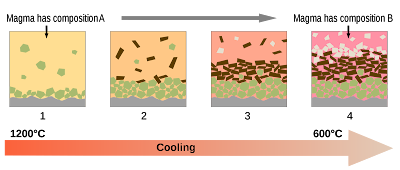
    As the magma begins to cools, it will begin to develop gems. This procedure is called crystallization also, it is similar to precipitation of gems from arrangements. Keep in mind when you needed to develop salt precious stones in secondary school science class? You took salt, broke up it in a glass of warm water and put a string in the glass to go about as a site of starting gem development or nucleation. The more drawn out that you cleared out the string in the arrangement, the greater the gems got to be. In the event that you were eager like me, you hauled the string out following a couple of minutes which was obviously, too early for any gems to have framed. On the off chance that you allowed the string to sit unbothered for a day or somewhere in the vicinity, precious stones too little to be seen with the stripped eye would have framed. After some time, layer after layer of salt is added to the seed gems making greater and greater precious stones. Following a couple of weeks, you could see the cubic propensity of halite. Crystallization of magma works the same way. Seed precious stones frame first and the gems simply get greater and greater and greater. Be that as it may, there are a few noteworthy contrasts between crystallization of magma and precipitation of salt precious stones. Not the minimum of which is that magma contains a blend of components and in this manner will shape a wide range of minerals as it takes shape. Salt water is unadulterated and just structures halite as an accelerate. Above 1800 degrees C, there are basically no strong parts to the melt. Everything is fluid. As the magma cools, seed precious stones of olivine start to structure. The concoction piece of olivine, at any rate as per your book, is (Mg,Fe)2SiO4. That olivine contains SiO4 ought to shock no one to you. The cations are Mg and Fe. Any mineral that contains these two components is called ferromagnesium. Ferromagnesium minerals have a tendency to be the main to frame from cooling magmas. As crystallization proceeds with, the olivine precious stones get bigger and extensive as layer upon layer is included to the seed precious stones. The final result is a mineralogical form of the "Gob-plug" confections that you used to pop in your mouths. You know the ones; they were multi-layered. The more you sucked them the outsider the hues got to be. You frequently see slight geochemical changes in the olivine gems as they develop. They much of the time begin off Mg rich, yet turn out to be more Fe rich after some time. This is called zonation. It is essential at this opportunity to advise you that olivine is very a solitary mineral. We simply regard it as one, yet olivine is really a mineral gathering. There are two end individuals, 1) Fayalite (Mg2SiO4) and 2) Forsterite (Fe2SiO4).As time goes on and the temperature starts to drop an increasing amount, different minerals start to take shape out of the magma. At around 1100 degrees C, another ferromagnesium mineral structures. Pyroxene (compound organization: Fe,Mg(SiO3)2) takes shape alongside olivine. This is an imperative idea. Crystallization of particular minerals is not successive; they cover one another. Every now and then 3 or 4 or more minerals are all taking shape in the meantime. When minerals start to shape in a melt, they begin to settle descending because of the impact of gravity. Minerals as strong substances tend to have higher particular gravities than the magma that they are taking shape from. Thus they sink descending. The procedure is called gravitational settling. The olivine-rich rock is called Dunite. The pyroxene-olivine-rich rock is called peridotite. As the magma keeps on cooling, diverse minerals begin to shape. The grouping that they take shape out in is known as the Bowen's Response Series. We'll get to that in a moment. In any case, initial, a remark about what happens to the magma as precious stones structure. The initial two minerals to shape from a cooling magma are olivine and pyroxene. Both of these minerals contain Mg, Fe, Si and O. As we examined before, the Earth's outside is basically formed of just 8 components. Four of them join to frame olivine and pyroxene. As olivine and pyroxene take shape, the relative rate of Mg and Fe drop in the remaining magma on the grounds that they are being uprooted by the minerals as they settle out of the melt. All the while, the relative convergences of Ca, Na, K and Al in the magma increment as olivine and pyroxene structure. This continuous change in magma piece is called fractionation or partial crystallization and it is to a great extent in charge of the mineral grouping containing the Bowen's response arrangement.

    Bowen's Reaction Series 

    N. L. Bowen was a Canadian molten mineralogist who directed lab probes crystallization in the ahead of schedule to mid 1900s. An associate of mine, now based at Harvard University, let me know that Bowen articulated an extremely significant articulation amid an address by a fairly presumptuous geologist who asserted that he had seen most illustrations of volcanic shakes all around the globe and was hence more qualified to conjecture their arrangement than other people who were lab-based. After the address, Bowen expressed that he generally felt that geologists should depend more on understanding than immediately. I don't completely concur with this, however we absolutely need to think without assumptions from time to time. Bowen exhibited that it was in fact conceivable to deliver a succession of minerals from a solitary magma source through cooling what's more, fractionation. The outline to one side condenses his work: Geologists tend to separate the Bowen's response arrangement into 4 parts as per mineral arrangement. These divisions are utilized to subdivide the volcanic rocks (molten rock arrangement). The accompanying table outlines the predominant mineralogy of the 4 volcanic structure sorts:

    Composition        Formation Temperature    Dominant Minerals                            Silica content 
    Ultramafic           Very high                         Olivine, pyroxene                                Very low (<45%) 
    Mafic                     High                               Olivine, pyroxene, Ca-plagioclase          low 
    Intermediate        Medium                            Na-Plagioclase, amphibole, biotite       moderate 
    Felsic                   Medium-low                  Orthoclase, quartz, muscovite, biotite      high (>65%) 

    الخميس، 27 أغسطس 2015

    Basics of Geology, Rocks and Minerals


    السبت، 21 مارس 2015

    Scoria


    What is Scoria?

    Scoria is a highly vesicular, dark coloured volcanic rock that may or may not contain crystals (phenocrysts). It is typically dark in colour (generally dark brown, black or purplish red), and basaltic or andesitic in composition. Scoria is relatively low in density as a result of its numerous macroscopic ellipsoidal vesicles, but in contrast to pumice, all scoria has a specific gravity greater than 1, and sinks in water. The holes or vesicles form when gases that were dissolved in the magma come out of solution as it erupts, creating bubbles in the molten rock, some of which are frozen in place as the rock cools and solidifies. Scoria may form as part of a lava flow, typically near its surface, or as fragmental ejecta (lapilli, blocks and bombs), for instance in Strombolian eruptions that form steep-sided scoria cones. Most scoria is composed of glassy fragments, and may contain phenocrysts. The word scoria comes from the Greek σκωρία, skōria, rust. An old name for scoria is cinder.

    Formation of scoria

    Scoria is formed of the explosive from the volcano when it explodes, excessive gases and ash goes out of the volcano. These gases are dissolved in the magma under pressure of the overburden. The magma from the explosion of the volcano goes into air where pressure is released and the magma solidifies as the temperature is dropped than that of the subsurface. As the magma solidifies, the gases in the melt are not released from the melt before it solidifies. These gases produces round or elongated pores. These pore are vesicles of the gases zones which are evident of the melt solidification rapidly else gases would not have been trapped.
    The scoria as formed from the explosion will be found near the mouth of the volcano and heavier rock would fall down the hill of the volcano. 

    Cinder cones

    Cinder cone are the steep hills formed by the brief eruption of a volcano where scoria is deposited at the mouth and stack at on another. These have vertical relief with less than few thousand feet. These hill are often formed at intervals. More than just one volcano erupts near to another to form from few cinder cones to hundreds of individual cones that forms a cluster. 
    Most of the scoria falls to the ground near the vent to build up a cone-shaped hill called a "cinder cone." Cinder cones are generally small volcanoes produced by brief eruptions with a total vertical relief of less than a few thousand feet. They are usually very steep because scoria has an angle of repose of 30 to 40 degrees. In some parts of the world, cinder cones occur in clusters of a few to hundreds of individual cones. These areas are called "volcano fields."
    An example is Maungarei in New Zealand, which like Te Tatua-a-Riukiuta in the south of the same city has been extensively quarried. Quincan, a unique form of Scoria, is quarried at Mount Quincan in Far North Queensland, Australia.

    Vesicular basalts

    When volcano erupts the melt has dissolved gases in it which due to release of pressure moves upward in the flow for its low weight. These gases attempt to escape the melt that's why it moves upward. As temperature and pressure is reduced the melt solidifies which in turn traps some of the gases. These gases produces vesicles in the rock body and the rock is called scoria or vesicular basalt.

    Not to be Confused with Pumice

    A vesicular igneous rock that is very similar to scoria is pumice. There are a few differences that can be used to distinguish them. First is their colour. Scoria is almost always black or dark gray to reddish brown, while pumice is almost always white to light gray to light tan. This colour difference is a result of their composition. Scoria forms from basaltic magma, while pumice forms from rhyolitic magmas which usually contain more gas.
    Pumice has a much higher concentration of trapped bubbles - so many that the walls between them are very thin. The vesicles in pumice contain enough air that the rock will float on water. The thick walls of scoria make it heavy enough to sink.
    Finally, when observed closely with a hand lens, you can often see tiny mineral crystals in scoria. However, close observation of pumice reveals a "glassy" texture similar to obsidian. Pumice consists mainly of glass materials rather than mineral crystals. A "glass" is a noncrystalline substance. In the case of pumice, it cooled so quickly that the atoms were unable to arrange themselves into ordered crystal structures.

    Uses of Scoria

    One of the main uses of scoria is in the production of lightweight aggregate. The scoria is crushed to desired sizes and sold for a variety of uses.
    Concrete made with scoria typically weighs about 100 pounds per cubic foot. This is a weight savings compared to concrete made with typical sand and gravel that weighs about 150 pounds per cubic foot. This savings in weight allows buildings to be constructed with less structural steel. The air trapped in the scoria makes the lightweight concrete a better insulator. Buildings constructed with this lightweight concrete can have lower heating and cooling costs.
    Crushed scoria is used as roofing granules, ground cover in landscape projects, and as a substrate in hydroponic gardening. Many dealers offer customers the option of choosing between black, brown, or red material. Scoria is also used as rip-rap, drainage stone, and low-quality road metal. Small amounts of scoria are used as sauna rock and as a heat sink in barbecue grills.

    Rhyolite


    What is Rhyolite?

    Rhyolite is an extrusive igneous rock with a very high silica content. It is usually pink or gray in colour with grains so small that they are difficult to observe without a hand lens. Rhyolite is made up of quartz, plagioclase, and sanidine, with minor amounts of hornblende and biotite. Trapped gases often produce vugs in the rock. These often contain crystals, opal, or glassy material.
    Many rhyolites form from granitic magma that has partially cooled in the subsurface. When these magmas erupt, a rock with two grain sizes can form. The large crystals that formed beneath the surface are called phenocrysts, and the small crystals formed at the surface are called groundmass.

    Rhyolite usually forms in continental or continent-margin volcanic eruptions where granitic magma reaches the surface. Rhyolite is rarely produced at oceanic eruptions. Rhyolite forms of the lava with high silica content so the lava is very viscous. If rhyolitic magma is rich in gases, it can erupt explosively which will solidify quickly forming pumice. Certain times extremely porous rhyolite lava flows occur and such flow allow degassing and subsequent collapse of lava which forms obsidian.

    Rhyolite can be considered as the extrusive equivalent to the plutonic granite rock, and consequently, outcrops of rhyolite may bear a resemblance to granite. Due to their high content of silica and low iron and magnesium contents, rhyolite melts are highly polymerized and form highly viscous lava. They also occur as breccias or in volcanic plugs and dikes. Rhyolites that cool too quickly to grow crystals form a natural glass or vitrophyre, also called obsidian. Slower cooling forms microscopic crystals in the lava and results in textures such as flow foliations, spherulitic, nodular, and lithophysal structures. Some rhyolite is highly vesicular pumice. Many eruptions of rhyolite are highly explosive and the deposits may consist of fallout tephra/tuff or of ignimbrites.
    Eruptions of rhyolite are relatively rare compared to eruptions of less felsic lava. Only three eruptions of rhyolite have been recorded since the start of the 20th century: at the St. Andrew Strait volcano in Papua New Guinea, Novarupta volcano in Alaska, and Chaiten in southern Chile.

    Eruptions of Granitic Magma


    Eruptions of granitic magma can produce rhyolite, pumice, obsidian, or tuff. These rocks have similar compositions but different cooling conditions. Explosive eruptions produce tuff or pumice. Effusive eruptions produce rhyolite or obsidian if the lava cools rapidly. These different rock types can all be found in the products of a single eruption.
    Eruptions of granitic magma are rare. Since 1900 only three are known to have occurred. These were at St. Andrew Strait Volcano in Papua New Guinea, Novarupta Volcano in Alaska, and Chaiten Volcano in Chile.
    Granitic magmas are rich in silica and often contain up to several percent gas by weight. As these magmas cool, the silica starts to connect into complex molecules. This gives the magma a high viscosity and causes it to move very sluggishly.
    The high gas content and high viscosity of these magmas are perfect for producing an explosive eruption. The viscosity can be so high that the gas can only escape by blasting the magma from the vent.
    Granitic magmas have produced some of the most explosive volcanic eruptions in Earth's history. Examples include Yellowstone in Wyoming, Long Valley in California, and Valles in New Mexico. The sites of their eruption are often marked by large calderas.
    Photo of a lava dome in the caldera of Mount St. Helens. Activity at St. Helens slowly extrudes thick lavas that gradually build domes in the caldera. This dome is composed of dacite, a rock that is intermediate in composition between rhyolite and andesite.

    Lava Domes

    Sluggish rhyolitic lava can slowly exude from a volcano and pile up around the vent. This can produce a mound-shaped structure known as a "lava dome." Some lava domes have grown to a height of several hundred meters.
    Lava domes can be dangerous. As additional magma extrudes, the brittle dome can become highly fractured and unstable. The ground can also change slope as the volcano inflates and contracts. This activity can trigger a dome collapse. A dome collapse can lower the pressure on the extruding magma. This sudden lowering of pressure can result in an explosion. It can also result in a debris avalanche of material falling from the tall collapsing dome. Many pyroclastic flows and volcanic debris avalanches have been triggered by a lava dome collapse.

    Composition of Rhyolite

    Rhyolite has composition similar to that of granite but with much smaller grains. It is composed of light colour silicates. Generally composition is quartz and plagioclase with less amount of orthoclase, biotite, amphibole, pyroxene and glass.

    Rhyolite and Gemstones

    Many gem deposits are hosted in rhyolite. These occur for a logical reason. The thick granitic lava that forms rhyolite often cools quickly while pockets of gas are still trapped inside of the lava. As the lava quickly cools, the trapped gas is unable to escape and forms cavities known as "vugs." Later, when the lava flow has cooled and hydrothermal gases or ground water move through, material can precipitate in the vugs. This is how some of the world's best deposits of red beryl, topaz, agate, jasper, and opal are formed. Gem hunters have learned this and are always on the lookout for vuggy rhyolite.

    Occurrence of Rhyolite

    Rhyolite in Europe

    • Etsch Valley Vulcanite Group near Bolzano and the surrounding area
    • Gréixer rhyolitic complex at Moixeró range (Catalonia, Spain)
    • Vosges
    • Iceland: all active and extinct central volcanoes, e.g. Torfajökull, Leirhnjúkur / Krafla, Breiddalur central volcano
    • Papa Stour in Shetland
    • Copper Coast Geopark in southeast Ireland
    • various locations around Snowdonia, Wales
    • Massif de l'Esterel, France

    Rhyolite in Germany

    • the Thuringian Forest consists mainly of rhyolites, latites and pyroclastic rocks of the Rotliegendes
    • Saxony, especially the north west
    • Saxony-Anhalt north of Halle
    • Saar-Nahe Basin e.g. the Königstuhl (Pfalz) on the Donnersberg mountain
    • Black Forest e.g. on the Karlsruher Grat
    • Odenwald

    Rhyolite in America

    • Andes
    • Cascade Range
    • Cobalt, Ontario Canada
    • Rocky Mountains
    • Jemez Mountains
    • Rhyolite, Nevada was named after a rhyolite deposit that characterised the area
    • St. Francois Mountains
    • Jasper Beach - Machiasport, Maine

    Rhyolite in Oceania

    • the Taupo Volcanic Zone in New Zealand has a large concentration of young rhyolite volcanoes
    • the Gondwana Rain forests of Australia World Heritage Area contains rhyolite-restricted flora along the Great Dividing Range

    Rhyolite in Asia

    • The Malani Igneous Suite, Rajasthan, India.
    • The Yandang Shan mountain chain, near the town of Wenzhou, Zhejiang province, China

    Pumice


    What is Pumice?

    Pumice is a light coloured, extremely porous igneous rock that forms during explosive volcanic eruptions. It is used as aggregate in lightweight concrete, as landscaping aggregate, and as an abrasive in a variety of industrial and consumer products. Many specimens have a high enough porosity that they can float on water until they slowly become waterlogged.
    Pumice, called pumicite in its powdered or dust form, is a volcanic rock that consists of highly vesicular rough textured volcanic glass, which may or may not contain crystals. It is typically light coloured. Scoria is another vesicular volcanic rock that differs from pumice in having larger vesicles, thicker vesicle walls and being dark coloured and denser.
    Pumice is created when super-heated, highly pressurised rock is violently ejected from a volcano. The unusual foamy configuration of pumice happens because of simultaneous rapid cooling and rapid depressurisation. The depressurisation creates bubbles by lowering the solubility of gases (including water and CO2) that are dissolved in the lava, causing the gases to rapidly ex-solve (like the bubbles of CO2 that appear when a carbonated drink is opened). The simultaneous cooling and depressurisation freezes the bubbles in a matrix. Eruptions under water are rapidly cooled and the large volume of pumice created can be a shipping hazard for cargo ships.

    Properties of Pumice

    Pumice is composed of highly microvesicular glass pyroclastic with very thin, translucent bubble walls of extrusive igneous rock. It is commonly, but not exclusively of silicic or felsic to intermediate in composition (e.g., rhyolitic, dacitic, andesite, pantellerite, phonolite, trachyte), but basaltic and other compositions are known. Pumice is commonly pale in colour, ranging from white, cream, blue or grey, to green-brown or black. It forms when volcanic gases ex-solving from viscous magma form bubbles that remain within the viscous magma as it cools to glass. Pumice is a common product of explosive eruptions (plinian and ignimbrite-forming) and commonly forms zones in upper parts of silicic lava. Pumice has an average porosity of 90%, and initially floats on water.
    Scoria differs from pumice in being denser. With larger vesicles and thicker vesicle walls, it sinks rapidly. The difference is the result of the lower viscosity of the magma that forms scoria. When larger amounts of gas are present, the result is a finer-grained variety of pumice known as pumicite. Pumice is considered a glass because it has no crystal structure. Pumice varies in density according to the thickness of the solid material between the bubbles; many samples float in water. After the explosion of Krakatoa, rafts of pumice drifted through the Pacific Ocean for up to 20 years, with tree trunks floating among them. In fact, pumice rafts disperse and support several marine species. In 1979, 1984 and 2006, underwater volcanic eruptions near Tonga created large pumice rafts, some as large as 30 kilometres (19 mi) that floated hundreds of kilometres to Fiji.
    There are two main forms of vesicles. Most pumice contains tubular microvesicles that can impart a silky or fibrous fabric. The elongation of the microvesicles occurs due to ductile elongation in the volcanic conduit or, in the case of pumiceous lava, during flow. The other form of vesicles are sub-spherical to spherical and result from high vapour pressure during eruption.

    How Does Pumice Form?

    The pore spaces (known as vesicles) in pumice are a clue to how it forms. The vesicles are actually gas bubbles that were trapped in the rock during the rapid cooling of a gas-rich frothy magma. The material cools so quickly that atoms in the melt are not able to arrange themselves into a crystalline structure. Thus, pumice is an amorphous volcanic glass known as a "mineraloid."
    Some magma contain several percent dissolved gas by weight while they are under pressure. Stop for a moment and think about that. Gas weighs very little at Earth's surface, but these magma under pressure can contain several percent gas by weight held in solution.
    This is similar to the large amount of dissolved carbon dioxide in a sealed bottle of carbonated beverage such as beer or soda. If you shake the container, then immediately open the bottle, the sudden release of pressure allows the gas to come out of solution, and the beverage erupts from the container in a frothy mess.
    A rising body of magma, supercharged with dissolved gas under pressure, behaves in a similar way. As the magma breaks through Earth's surface, the sudden pressure drop causes the gas to come out of solution. This is what produces the enormous rush of high-pressure gas from the vent.
    This rush of gas from the vent shreds the magma and blows it out as a molten froth. The froth rapidly solidifies as it flies through the air and falls back to Earth as pieces of pumice. The largest volcanic eruptions can eject many cubic kilometres of material. This material can range in size from tiny dust particles to large blocks of pumice the size of a house.
    Large eruptions can blanket the landscape around the volcano with over 100 meters of pumice and launch dust and ash high into the atmosphere.
    The sections below give quotations from United States Geological Survey reports describing the production of pumice at two major eruptions.

    Composition of Pumice

    Pumice is often formed from the rhyolitic lava which is usually light coloured and are rarely formed from the erupted basaltic or andesitic composition.

    Pumice has low specific gravity

    The pumice is made from the gas escapes of the volcanic eruption. This makes abundant vesicles of the pumice to float on water surface. The pumice have thin walls which makes it light weight and the specific gravity of pumice is less than one that gives it the ability to float on water surface. When abundant pumice is deposited by the lava flow, sometimes large amount enough that makes an island which can float for a some years till the time when island is water saturated and it sinks to bottom.

    Gas and Pumice at the Pinatubo Eruption 

    The second most powerful volcanic eruption of the 20th century was at Mount Pinatubo in 1991. The description below explains how enormous volumes of dissolved gas powered the eruption and how a cubic mile of ash and pumice lapilli was blasted from the volcano.

    Mount Mazama Eruption (Crater Lake)

    The cataclysmic eruption of Mount Mazama 7,700 years ago started from a single vent on the northeast side of the volcano as a towering column of pumice and ash that reached some 30 miles high. Winds carried the ash across much of the Pacific Northwest and parts of southern Canada. So much magma erupted that the volcano began to collapse in on itself. As the summit collapsed, circular cracks opened up around the peak. More magma erupted through these cracks to race down the slopes as pyroclastic flows. Deposits from these flows partially filled the valleys around Mount Mazama with up to 300 feet of pumice and ash. As more magma was erupted, the collapse progressed until the dust settled to reveal a volcanic depression, called a caldera, 5 miles in diameter and one mile deep.

    Uses of Pumice

    Pumice is widely used to make lightweight concrete or insulative low-density cinder blocks. When used as an additive for cement, a fine-grained version of pumice called pozzolan is mixed with lime to form a light-weight, smooth, plaster-like concrete. This form of concrete was used as far back as Roman times. Roman engineers used it to build the huge dome of the Pantheon and as construction material for many aqueducts.
    It is also used as an abrasive, especially in polishes, pencil erasers, cosmetic exfoliants, and the production of stone-washed jeans. "Pumice stones" are often used in beauty salons during the pedicure process to remove dry and excess skin from the bottom of the foot as well as calluses. It was also used in ancient Greek and Roman times to remove excess hair. Finely ground pumice is added to some toothpastes and heavy-duty hand cleaners (such as Lava soap) as a mild abrasive. Pumice is also used as a growing substrate for growing horticultural crops. Some brands of chinchilla dust bath are made of powdered pumice.
    Owing to its high demand particularly for water filtration, chemical spill containment, cement manufacturing, horticulture and increasingly for the pet industry, the mining of pumice in environmentally sensitive areas has been under more scrutiny after such an operation was stopped in the U.S. state of Oregon, at Rock Mesa in the southern part of the Three Sisters Wilderness.
    The other use of pumice is as a decorative in landscaping and is used as drainage rock and soil in planting.

    Obsidian

    What is Obsidian?

    Obsidian is a naturally occurring volcanic glass formed as an extrusive igneous rock. It is produced when felsic lava extruded from a volcano cools rapidly with minimal crystal growth. Obsidian is commonly found within the margins of rhyolitic lava flows known as obsidian flows, where the chemical composition (high silica content) induces a high viscosity and polymerisation degree of the lava. The inhibition of atomic diffusion through this highly viscous and polymerised lava explains the lack of crystal growth. Obsidian is hard and brittle; it therefore fractures with very sharp edges, which were used in the past in cutting and piercing tools, and it has been used experimentally as surgical scalpel blades.

    Origin and properties of obsidian

    Obsidian is the rock formed as a result of quickly cooled lava, which is the parent material. Tektites were once thought by many to be obsidian produced by lunar volcanic eruptions, though few scientists now adhere to this hypothesis.
    Obsidian is mineral-like, but not a true mineral because as a glass it is not crystalline; in addition, its composition is too complex to comprise a single mineral. It is sometimes classified as a mineraloid. Though obsidian is usually dark in colour similar to mafic rocks such as basalt, obsidian's composition is extremely felsic. Obsidian consists mainly of SiO2 (silicon dioxide), usually 70% or more. Crystalline rocks with obsidian's composition include granite and rhyolite. Because obsidian is metastable at the Earth's surface (over time the glass becomes fine-grained mineral crystals), no obsidian has been found that is older than Cretaceous age. This breakdown of obsidian is accelerated by the presence of water. Having a low water content when newly formed, typically less than 1% water by weight, obsidian becomes progressively hydrated when exposed to groundwater, forming perlite.
    Pure obsidian is usually dark in appearance, though the colour varies depending on the presence of impurities. Iron and other transition elements may give the obsidian a dark brown to black colour. Very few samples are nearly colourless. In some stones, the inclusion of small, white, radially clustered crystals of cristobalite in the black glass produce a blotchy or snowflake pattern (snowflake obsidian). Obsidian may contain patterns of gas bubbles remaining from the lava flow, aligned along layers created as the molten rock was flowing before being cooled. These bubbles can produce interesting effects such as a golden sheen (sheen obsidian). An iridescent, rainbow-like sheen (rainbow obsidian) is caused by inclusions of magnetite nanoparticles.

    Colour of obsidian

    Obsidian mainly forms of black colour however this colour is not the only one but is the most common colour. It can also be of different colours like brown, tan or green. Rare colours of obsidian can also be blue, red, orange or yellow. The colour of obsidian is thought to be from the trace elements. Two colours can also be found at a single obsidian where black and brown are the most common to occur being associated at a single rock body. Rarely obsidian can be of iridescent where are called as rainbow obsidian, golden obsidian or silver obsidian.

    Occurrence of obsidian 

    Obsidian can be found in locations which have experienced rhyolitic eruptions. It can be found in Argentina, Armenia, Azerbaijan, Australia, Canada, Chile, Georgia, Greece, El Salvador, Guatemala, Iceland, Italy, Japan, Kenya, Mexico, New Zealand, Papua New Guinea, Peru, Scotland, Turkey and the United States. Obsidian flows which may be hiked on are found within the calderas of Newberry Volcano and Medicine Lake Volcano in the Cascade Range of western North America, and at Inyo Craters east of the Sierra Nevada in California. Yellowstone National Park has a mountainside containing obsidian located between Mammoth Hot Springs and the Norris Geyser Basin, and deposits can be found in many other western U.S. states including Arizona, Colorado, New Mexico, Texas, Utah, Washington, Oregon and Idaho. Obsidian can also be found in the eastern U.S. states of Virginia, as well as Pennsylvania and North Carolina.
    There are only four major deposit areas in the central Mediterranean: Lipari, Pantelleria, Palmarola and Monte Arci. Ancient sources in the Aegean were Melos and Giali. Acigöl town and the Göllü Dağ volcano were the most important sources in central Anatolia, one of the more important source areas in the prehistoric Near East.

    Stability of obsidian

    Obsidian is a glass where lava flow solidifies rapidly forming no crystalline structure but it is also not stable at this form and with time begins forming crystals not at the whole rock body but at different parts of the obsidian. It is not at a regular time interval so great time is required to get obsidian crystalline form.

    Composition

    Most obsidians have a composition similar to rhyolite and granite. Granites and rhyolites can form from the same magma as obsidian and are often geographically associated with the obsidian.
    Rarely, volcanic glasses are found with a composition similar to basalt and gabbro. These glassy rocks are named "tachylyte."

    Volcanic glasses other than obsidian

    Pumice, scoria, and tachylyte are other volcanic glasses formed by rapid cooling. Pumice and scoria differ from obsidian by having abundant vesicles - cavities in the rock produced when gas bubbles were trapped in a solidifying melt. Tachylyte differs in composition - it has a composition similar to basalt and gabbro.

    Where Does Obsidian Form?

    Obsidian is usually an extrusive rock - one that solidifies above Earth's surface. However, it can form in a variety of cooling environments:
    • along the edges of a lava flow (extrusive)
    • along the edges of a volcanic dome (extrusive)
    • around the edges of a sill or a dike (intrusive)
    • where lava contacts water (extrusive)
    • where lava cools while airborne (extrusive) 

    Uses of Obsidian

    Historical use

    The first known archaeological evidence of usage was in Kariandusi and other sites of the Acheulian age (beginning 1.5 million years BP) dated 700,000 BC, although the number of objects found at these sites were very low relative to the Neolithic. Use of obsidian in pottery of the Neolithic in the area around Lipari was found to be significantly less at a distance representing two weeks journeying. Anatolian sources of obsidian are known to have been the material used in the Levant and modern-day Iraqi Kurdistan from a time beginning sometime about 12,500 BC. The first attested civilised use is from excavations at Tell Brak dated the late fifth millennia. Obsidian was valued in Stone Age cultures because, like flint, it could be fractured to produce sharp blades or arrowheads. Like all glass and some other types of naturally occurring rocks, obsidian breaks with a characteristic conchoidal fracture. It was also polished to create early mirrors. Modern archaeologists have developed a relative dating system, obsidian hydration dating, to calculate the age of obsidian artefacts. Obsidian is used as a cutting tool because of its conchoidal fracturing where it breaks into thin sheets and have sharp edges. In stone age obsidian was used as a cutting tool for making any sharp tool and it is still used as a cutting tool in modern surgeries. It is also used as a jewellery by making beads of obsidian.

    Uses of Obsidian as a Cutting Tool

    The conchoidal fracture of obsidian causes it to break into pieces with curved surfaces. This type of fracturing can produce rock fragments with very sharp edges. These sharp fragments may have prompted the first use of obsidian by people.
    The first use of obsidian by people probably occurred when a sharp piece of obsidian was used as a cutting tool. People then discovered how to skillfully break the obsidian to produce cutting tools in a variety of shapes. Obsidian was used to make knives, arrowheads, spear points, scrapers, and many other weapons and tools.
    Once these discoveries were made, obsidian quickly became the raw material of preference for producing almost any sharp object. The easy-to-recognise rock became one of the first targets of organised "mining." It is probably a safe bet that all natural obsidian outcrops that are known today were discovered and utilised by ancient people.

    Obsidian in Modern Surgery

    Although using a rock as a cutting tool might sound like "stone age equipment," obsidian continues to play an important role in modern surgery. Obsidian can be used to produce a cutting edge that is thinner and sharper than the best surgical steel. Today, thin blades of obsidian are placed in surgical scalpels used for some of the most precise surgery. In controlled studies, the performance of obsidian blades was equal to or superior to the performance of surgical steel.

    Uses of Obsidian in Jewellery

    Obsidian is a popular gemstone. It is often cut into beads and cabochons or used to manufacture tumbled stones. Obsidian is sometimes faceted and polished into highly reflective beads. Some transparent specimens are faceted to produce interesting gems.
    The use of obsidian in jewellery can be limited by its durability. It has a hardness of about 5.5 which makes it easy to scratch. It also lacks toughness and is easily broken or chipped upon impact. These durability concerns make obsidian an inappropriate stone for rings and bracelets. It is best suited for use in low-impact pieces such as earrings, brooches, and pendants.
    Obsidian is also used in making opal doublets and opal triplets. Thin slices or chips of opal are glued to a thin slice of obsidian to make a composite stone. The black obsidian provides an inexpensive and colour-contrasting background that makes opal's colourful fire much more obvious. It also adds mass and stability to the opal that facilitates cutting it into a gem.

    Other Uses

    Freshly broken pieces of obsidian have a very high luster. Ancient people noticed that they could see a reflection in obsidian and used it as a mirror. Later, pieces of obsidian were ground flat and highly polished to improve their reflective abilities.
    Obsidian's hardness of 5.5 makes it relatively easy to carve. Artists have used obsidian to make masks, small sculptures, and figurines for thousands of years.

    Interested for our works and services?
    Get more of our update !